No one left behind
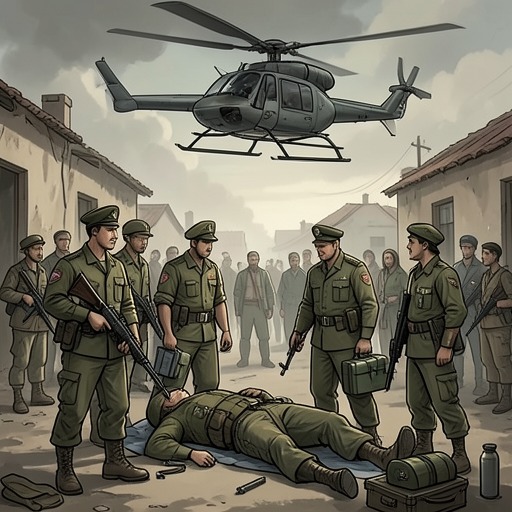
Black Hawk DownNo one left behind is the Rangers’ commitment to aid endangered comrades and recover the dead, an obligation that gave the fight in Mogadishu a force beyond the mission’s original objectives. It drew men toward the crash sites even as enemy fire, confusion, and the danger to the living made every rescue attempt costly.
Meaning and Origins
The commitment became urgent when a Black Hawk helicopter went down and the men on the ground knew that its six crew members needed help before Somali fighters reached them. The crash also revived a recent fear: two weeks earlier, the crew of another downed Black Hawk had been mutilated by crowds. The Rangers had discussed that fate in the hangar and resolved that it would not happen to their own men. Their impulse to move toward the wreck was therefore both immediate concern for trapped comrades and a determination to protect them from what might follow capture or death. For the soldiers, the obligation was not abstract: it meant going back into a city where the mission had become a pitched battle.
Duty, Command, and the Cost of Rescue
The impulse to move toward the crash did not erase the responsibilities already assigned on the ground. Nelson saw smoke and dust rising three blocks east and crowds running toward the wreck, but Chalk Two could not simply abandon its position: Captain Mike Steele knew that its departure would break the security perimeter around the target building. He tried to reach the command network as Nelson pressed to go, but overlapping radio traffic made it impossible for him to be heard. The men’s urgency collided with a wider duty to hold the position, while the command structure itself struggled to keep pace with the crisis.
Elsewhere, rescue plans were being undone by the battle’s geography and confusion. Groups moving from the target building toward the crash site became scattered and pinned down, with no single commander over the mixed Ranger and Commando elements. The convoy meant to meet them had lost its way under fire and was close to turning back. Little Bird gunships could not safely shoot at gunmen among the American troops, and after two Black Hawks had been shot down, no helicopter could land to evacuate the growing number of wounded. The obligation to retrieve comrades remained, but neither air support nor a reliable route could make that obligation straightforward.
The danger of moving wounded men and the dead into that fire prompted a direct challenge to command. When Sean Watson was told to prepare to move, he bluntly objected: the group had five wounded men, two of whom had to be carried, and the body of Commando Sergeant First Class Earl Fillmore, shot in the head. Four men would be needed for each litter, Watson warned, turning the carriers into conspicuous targets; he argued that the well-defended courtyard could withstand an attack. His objection set the human cost of rescue against the risk of exposing still more soldiers, rather than treating the duty as a simple command to advance.
At the wreck, recovery meant confronting a physical barrier as well as hostile fire. Tim Wilkinson found Cliff Wolcott dead in the crushed cockpit, its folded front end pinning him from the waist down. Wilkinson tried to reach his legs, then crawled behind the pilot’s seat and dug beneath the smashed underside, but the helicopter had plowed hard into the soil and offered no easy way to free the body. The team nevertheless would not leave without Wolcott. The commitment extended beyond rescuing the living: it required bringing the dead home even when the wreckage made that promise difficult to keep.
Cohesion, Fear, and Its Limits
The commitment to comrades was not felt uniformly, and the contrast between Dale Sizemore and Steve Anderson shows how the same battle could produce opposite impulses. Sizemore, a Ranger from Illinois nicknamed Adonis, had been unable to join the mission because a cast immobilized his arm after he injured his elbow wrestling with a Commando colonel. When the convoy later prepared to fight toward the crash site, he was eager to go. Anderson, also from Illinois and Sizemore’s friend, felt dread instead. Slender, quiet, and asthmatic, he had shrapnel in his legs from an earlier night mission; the wounds had weakened the enthusiasm he had once shared with the other Rangers. Radio chatter and distant gunfire made him want to escape, and the sight of Dominick Pilla dead and Todd Blackburn badly injured sharpened his doubts about what they were doing in Mogadishu. The pull of the group could summon one man toward danger while leaving another struggling to conceal his fear.
Brad Thomas’s hesitation made that struggle explicit. After Pilla had died in Thomas’s lap in the Humvee, Thomas told Struecker that he could not return to the city. He had married only a few months earlier and had decided he would not go out and die; the account presents this not as a sudden loss of composure but as a considered choice he knew would carry a steep price in a Ranger unit. Struecker, himself married, did not dismiss the fear or call Thomas a coward. He acknowledged that he was scared too, then appealed to their job and to what a person does while afraid. Thomas walked away, but when the vehicles were about to leave, he had climbed aboard. The scene turns the obligation to go back into a test of action under fear, not proof that fear is absent.
That solidarity also had a perilous moral edge. At the outset, the Rangers’ rules of engagement permitted them to fire only at someone pointing a weapon, even as armed men moved among women and children. During the convoy’s retreat, Eric Spalding first shouted a warning when a woman carrying a baby ran beside the vehicle; when she turned and raised a pistol, he shot her, then feared he might also have hit the infant. Later, as the vehicles fought their way back to base, the rules of engagement were off. Sizemore, driven by numbness, anger, and the desire to get his friends home, shot young boys, some armed and some not, and fired into crowds that included women alongside riflemen. The account places the fierce protection of comrades beside the lethal consequences of a battle in which civilians and fighters were difficult to separate: the bond that carried men back toward one another could also narrow their attention to the survival of their own.
Recovery and Readiness After the Return
The obligation did not end when the men reached the hangar. Some troops had been flown back early and were already cleaning their weapons, checking their gear, and restocking ammunition, prepared to go back out. Mike Steele received the accurate casualty list only after returning to the hangar, where a first sergeant saluted him and said, “Rangers lead the way, sir.” The scene closes on a force taking stock of its losses while remaining ready to return: recovering comrades and the dead was not separate from the unit’s continuing sense of duty.